
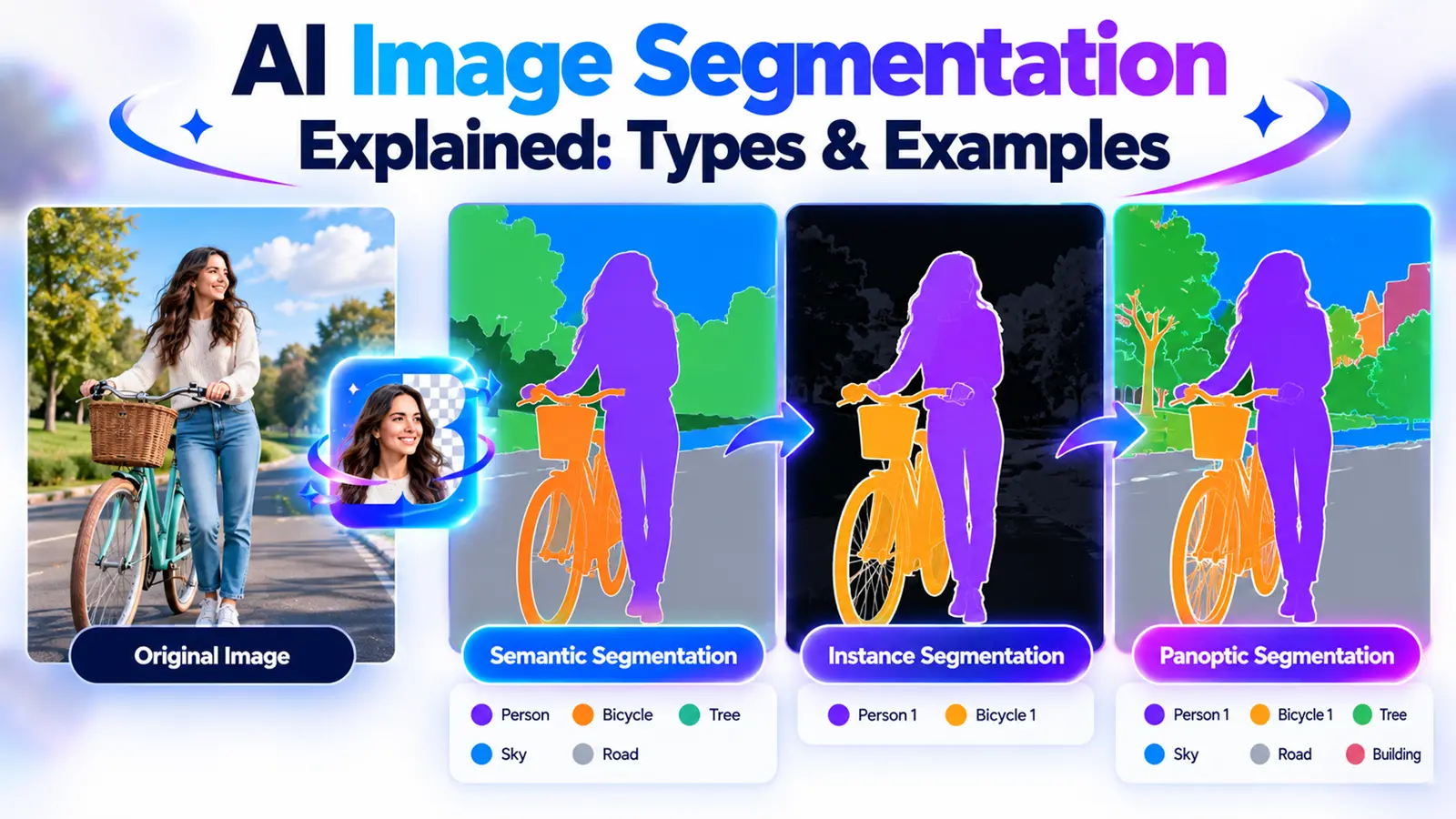
AI image segmentation is a computer vision technique that helps computers identify and separate meaningful regions within an image. Instead of simply recognizing that a picture contains a person or a car, segmentation can determine which pixels belong to those objects. This capability is useful in applications ranging from medical imaging and autonomous vehicles to AI background removal. In this guide, we'll explain how image segmentation works, explore its main types, compare it with other computer vision techniques, and show how segmentation helps create cleaner image cutouts.
What Is AI Image Segmentation?
AI image segmentation is the process of dividing an image into meaningful regions by assigning labels or grouping pixels based on visual information. Deep learning models can learn to recognize objects and boundaries, producing masks that identify different parts of an image.
A simple example makes the distinction clear. Imagine a photo containing a woman, a bicycle, a tree, and the sky:
Image classification: "This image belongs to a category such as ‘bicycle’."
Object detection: "The bicycle is located inside this bounding box."
Image segmentation: "These exact pixels belong to the bicycle."
Segmentation is the only one of the three that answers the question at the pixel level, rather than just naming or locating the object.
Why Is Image Segmentation Important?
Traditional image recognition can identify what's in a photo, but many real applications need detailed spatial information instead of just a label. Segmentation helps systems:
Identify object boundaries
Separate foreground and background
Understand a scene as a whole
Measure regions within an image
Support object editing
Analyze medical structures
Assist autonomous systems
Generate object masks
The main advantage over simpler techniques is pixel-level or region-level understanding, rather than just knowing an object is present somewhere in the frame.
How Does AI Image Segmentation Work?
Input image. A photograph or image is supplied to the model.
Feature extraction. The model analyzes learned visual patterns, textures, shapes, and context.
Pixel or region prediction. The system predicts which categories or objects different pixels belong to.
Segmentation mask. Predictions are represented as labeled regions or masks.
Output and refinement. Masks may be resized, cleaned, or combined with other processing steps.
This is a simplified conceptual pipeline — individual models can use different architectures and steps, and not every system follows this exact sequence.
What Is a Segmentation Mask?
A segmentation mask is a representation that indicates which pixels belong to a class, region, or object. A few common forms:
Binary mask. 0 = background, 1 = foreground.
Multi-class mask. For example: 0 = background, 1 = person, 2 = bicycle, 3 = tree.
Instance mask. Separate masks for individual objects, even when they belong to the same category.
A binary segmentation mask and a continuous alpha matte represent different kinds of information. A binary mask separates foreground from background, while an alpha matte can represent partial transparency along soft or complex edges.
What Are the Main Types of Image Segmentation?
Three task formulations come up most often:
Semantic segmentation
Instance segmentation
Panoptic segmentation
Other formulations exist too, including binary foreground segmentation, interactive segmentation, and prompt-based segmentation, which are covered later in this guide.
What Is Semantic Segmentation?
Semantic segmentation assigns a category label to each pixel. If an image has three people, all of the pixels belonging to any of them simply receive the label "person" — the model doesn't necessarily distinguish person #1 from person #2.
Typical applications:
Road scene analysis
Land-cover mapping
Medical image analysis
Background/foreground classification
What Is Instance Segmentation?
Instance segmentation identifies individual object instances. With the same three-person photo, instance segmentation would separate Person 1, Person 2, and Person 3, each with their own mask.
This is useful for:
Counting objects
Separating overlapping objects
Tracking individual entities
Selecting one specific object for editing
What Is Panoptic Segmentation?
Panoptic segmentation combines semantic and instance-level scene understanding. It distinguishes countable object instances — often called "things," such as people, cars, and bicycles — while also labeling amorphous background regions, often called "stuff," such as sky, road, and grass.
This combined view is particularly useful for complete scene understanding, where both individual objects and the surrounding context matter.
Semantic vs Instance vs Panoptic Segmentation
Instance segmentation is not simply a more accurate version of semantic segmentation. The two approaches solve different labeling tasks: semantic segmentation groups pixels by category, while instance segmentation distinguishes individual objects within a category.
What Is Binary Image Segmentation?
Binary segmentation separates two classes, often foreground and background — for example, foreground = person, background = everything else. This is highly relevant to background-removal tools like ByByBG.
However, a binary mask alone may not preserve partial transparency around complex boundaries, such as fine hair or semi-transparent materials — this limitation is covered in more detail later in this guide.
Image Segmentation vs Image Classification
Classification answers "what is in the image?" Segmentation answers "which pixels belong to which regions?"
For a photo of a cat sitting on a sofa, classification might identify the image as containing a cat, while segmentation can identify the cat's specific pixel region within the frame.
Image Segmentation vs Object Detection
Object detection and segmentation aren't mutually exclusive — they can also be combined in a single system, where detection locates an object and segmentation then refines its exact shape.
Image Segmentation vs Edge Detection
Edge detection identifies image intensity or color transitions, while segmentation identifies meaningful regions or object membership. Edges alone don't automatically indicate which side belongs to a particular object.
For example, a shirt contains many folds and edges, but those edges don't necessarily represent separate objects — segmentation is still needed to determine that all of those regions belong to the same shirt.
Image Segmentation vs Alpha Matting
Segmentation asks: which pixels belong to the subject? Matting asks: how much of the foreground contributes to each pixel? These two questions are related, but they are not identical — and that difference matters most around fine, complex edges.
This distinction is especially visible with hair — see How to Remove Background from Hair for a practical look at why fine strands are harder to extract cleanly than a solid object.
How Image Segmentation Helps Remove Backgrounds
At a conceptual level, a background-removal system needs to determine which parts of an image to preserve. Segmentation can support this by identifying the subject, and additional processing can then improve soft edges and transparency:
Original Image
↓
AI Identifies Foreground
↓
Segmentation Mask
↓
Boundary / Alpha Processing
↓
Background Separation
↓
Transparent Image
This is a general conceptual workflow for how segmentation-related techniques can support background removal — it isn't a claim about ByByBG's specific internal architecture.
Why Segmentation Alone May Not Produce Perfect Cutouts
A handful of cases tend to be difficult for segmentation on its own:
Fine hair
Transparent glass
Smoke
Motion blur
Fur
Shadows
Similar foreground/background colors
A hard binary mask can produce unnatural-looking edges in these cases. High-quality extraction often needs matting, boundary refinement, or manual correction on top of the initial segmentation.
For a broader look at why results sometimes fall short, see Why AI Background Removal Sometimes Fails.
How AI Separates Foreground and Background
The model relies on learned visual information rather than a single simple rule, including:
Object appearance
Texture
Color patterns
Shapes
Spatial relationships
Scene context
Important: AI doesn't simply remove one specific background color. It uses contextual understanding to distinguish foreground objects even against complex, varied backgrounds.
What Is Deep Learning Image Segmentation?
Deep learning segmentation models learn patterns from training data. During training, images paired with reference annotations teach a model to predict segmentation labels or masks.
It's worth separating two distinct phases: training, where the model learns from data, and inference, where an already-trained model predicts a mask for a brand-new image it hasn't seen before.
Traditional Image Segmentation vs AI Segmentation
Traditional methods aren't obsolete — thresholding and classical image-processing techniques can still be useful in controlled conditions, such as a fixed lighting setup or a known, uniform background.
What Is U-Net in Image Segmentation?
U-Net is an encoder-decoder neural-network architecture originally developed for biomedical image segmentation. A few important ideas behind it:
The encoder captures context across the image
The decoder reconstructs spatial predictions
Skip connections help preserve spatial detail that might otherwise be lost
U-Net is influential and widely used, but it isn't the only or universally best segmentation architecture — different tasks often call for different models.
What Is Mask R-CNN?
Mask R-CNN extends object-detection-style processing to predict an object mask for each detected instance. It's useful for:
Instance segmentation
Separating multiple objects
Generating object-specific masks
What Is DeepLab?
DeepLab is a family of semantic segmentation approaches associated with techniques such as atrous (dilated) convolution and multi-scale context. A full mathematical breakdown of its architecture is outside the scope of this guide — the short version is that DeepLab-style models are designed to capture detail at multiple scales within an image.
What Is the Segment Anything Model (SAM)?
Segment Anything is a family of promptable segmentation models developed by Meta. Users or systems can provide prompts — such as points or boxes — to indicate the regions they're interested in.
A few clarifications worth keeping in mind:
Segmentation doesn't necessarily equal transparent PNG generation
A predicted object mask may still require matting or compositing before it looks like a clean cutout
Different versions of SAM have different capabilities, and those capabilities continue to evolve
CNNs vs Vision Transformers for Segmentation
At a high level, CNN-based approaches learn spatial features through convolutional operations, while transformer-based approaches use attention mechanisms to model relationships between image features across the whole image.
Modern segmentation systems often combine ideas from both architectures rather than treating the choice as settled in favor of one or the other.
What Is Prompt-Based Image Segmentation?
A user or model may guide segmentation using a point, a bounding box, an existing mask, or — when supported by the system — a text prompt. For example, clicking on a person in an image to request a mask for that specific person.
This is different from fully automatic background removal, where the tool selects the subject on its own without a user-provided spatial prompt.
What Is Interactive Image Segmentation?
Interactive segmentation allows a user to guide or correct object selection — for example, selecting a subject, adding foreground hints, marking background regions, or refining an existing mask.
Note: ByByBG does not currently offer interactive segmentation controls like these — this section describes the general concept, not a ByByBG feature.
Real-World Applications of AI Image Segmentation
Segmentation shows up across a wide range of fields, not just photo editing:
Photo editing
Background removal
Medical imaging
Autonomous driving
Satellite imagery
Agriculture
Manufacturing
Robotics
Retail and e-commerce
Video editing
AI Image Segmentation in Photo Editing
Subject selection
Background replacement
Object isolation
Selective color adjustments
Portrait editing
Compositing
This is the area most directly connected to tools like ByByBG, where segmentation-related techniques support identifying the subject before the background is removed.
AI Image Segmentation in Medical Imaging
Identifying anatomical structures
Segmenting organs
Delineating lesions
Measuring image regions
Segmentation supports clinical workflows, but model predictions require appropriate validation and expert oversight — segmentation on its own does not provide a medical diagnosis.
AI Image Segmentation in Autonomous Driving
Road regions
Lane-related scene regions
Pedestrians
Vehicles
Sidewalks
Obstacles
Autonomous systems rely on multiple sensors and perception methods working together, not segmentation alone.
AI Image Segmentation in Satellite Imagery
Land-cover classification
Water-body identification
Urban development analysis
Vegetation mapping
Environmental monitoring
AI Image Segmentation in Agriculture
Crop-region identification
Weed segmentation
Plant disease region analysis
Field monitoring
Fruit detection and segmentation
Segmentation can highlight regions of interest in a field or a plant, but it doesn't by itself provide a reliable disease diagnosis — that still depends on proper validation.
AI Image Segmentation in E-commerce
Product cutouts
Background removal
Catalog image preparation
Product-region selection
Automated editing pipelines
This is the application most relevant to online sellers — see How to Remove Background from Product Photos.
Common Challenges in AI Image Segmentation
Several of these same challenges show up directly in background removal — see Why AI Background Removal Sometimes Fails.
How Is Image Segmentation Accuracy Measured?
Intersection over Union (IoU). Measures the overlap between the predicted region and the reference (ground-truth) region — the area where both agree, divided by the total area covered by either.
Dice coefficient. A related measure of overlap similarity between the prediction and the reference region.
A few other metrics are also used:
Pixel accuracy
Mean IoU, averaged across classes
Boundary-specific metrics
Instance segmentation average precision
Other task-specific quality metrics
No single metric captures every visual issue on its own — a score can look strong overall while fine details like hair edges still show visible problems.
Does Higher Segmentation Accuracy Mean Better Background Removal?
Not always. A mask can score well on large subject regions but still have visible errors around:
Hair
Fingers
Transparent objects
Thin clothing details
Soft edges
For background removal specifically, visual quality and alpha-boundary accuracy matter just as much as overall region overlap — a high aggregate score doesn't guarantee a clean-looking cutout.
Can Image Segmentation Work in Real Time?
Yes, depending on the model architecture, hardware, input resolution, number of objects, required accuracy, and deployment environment. Examples include live camera effects, video calls, robotics, and real-time scene understanding.
Not every segmentation model is designed or optimized to run in real time — larger, more detailed models can trade speed for accuracy.
AI Image Segmentation vs Manual Selection
Automation and manual refinement aren't competing options — they complement each other, with AI handling the bulk of the work and manual correction stepping in for the hardest cases.
What Is the Future of AI Image Segmentation?
A few directions current research points toward, framed as areas of active work rather than guaranteed outcomes:
More capable promptable segmentation
Improved consistency across video frames
More efficient models suited to mobile devices
Better prediction of fine boundaries
Stronger integration with editing tools
Reduced annotation requirements for training
More robust performance across varied image types
Try AI Background Removal with ByByBG
Image segmentation is one of the computer vision concepts that helps explain how AI systems identify subjects and separate image regions. If you want to experience automatic background removal, upload a photo to ByByBG and generate a transparent PNG.
Try AI Background Removal →
Frequently Asked Questions
AI image segmentation is a computer vision technique that divides an image into meaningful regions by assigning labels or grouping pixels, producing masks that identify different parts of the image.
At a conceptual level, a model takes an input image, extracts visual features, predicts which regions pixels belong to, and produces a segmentation mask, which may then be refined.
Semantic segmentation, instance segmentation, and panoptic segmentation are the three most commonly discussed types, though other formulations like binary and interactive segmentation also exist.
Semantic segmentation assigns a category label to every pixel, without distinguishing between separate objects of the same category.
Instance segmentation identifies individual object instances, giving each one its own mask even when multiple objects share the same category.
Panoptic segmentation combines semantic and instance segmentation, labeling both countable object instances and background regions in a single unified output.
A segmentation mask is a representation — often an image of labels or values — that indicates which pixels belong to a given class, region, or object.
Object detection locates objects using bounding boxes, while segmentation identifies the exact pixels that belong to each object, producing a more detailed shape.
Segmentation identifies which pixels belong to a subject, while alpha matting estimates how much each pixel is covered by the foreground — matting is better suited to soft, partially transparent edges like fine hair.
Segmentation can identify the subject as a foundation for background removal, but high-quality results for complex edges often need additional processing like matting or refinement.
Common examples include U-Net, Mask R-CNN, DeepLab, and the Segment Anything Model (SAM), among others — different models suit different tasks.
U-Net is an encoder-decoder neural network architecture originally developed for biomedical image segmentation, known for its use of skip connections to preserve spatial detail.
Segment Anything (SAM) is a family of promptable segmentation models developed by Meta, where a user or system provides prompts like points or boxes to guide which regions get segmented.
Common metrics include Intersection over Union (IoU), the Dice coefficient, pixel accuracy, and instance segmentation average precision, among others.
Segmentation is used in photo editing, background removal, medical imaging, autonomous driving, satellite imagery analysis, agriculture, manufacturing, robotics, e-commerce, and video editing.
Conclusion
AI image segmentation is the foundational computer vision technique behind a wide range of applications, including background removal — it's what lets a system understand which pixels belong to a subject rather than simply recognizing that the subject is present. A good segmentation mask is a strong starting point, but it doesn't automatically guarantee a visually perfect transparent cutout: for fine hair and partially transparent objects, matting and boundary quality matter just as much as identifying the correct foreground region in the first place.
Ready to see it in action? Try AI Background Removal →